


Double Trouble
One area of active ETFs attracting investors in droves is single stock ETFs. More than 660 of these were launched between January 2025 and August 2026.
As the name suggests, these funds give investors exposure to the performance of one particular stock. Most are based on household name stocks. Over 73% of the assets held by single stock ETFs are focused on popular tech stocks like Nvidia, Tesla, or SpaceX.
You might be wondering what’s the point of a single stock ETF when you can just buy shares of the company directly. Well, the vast majority1 of single stock ETFs are levered, meaning when the price of the underlying stock changes, the ETF’s value moves by a multiple of that change. For example, a 2X ETF gains double the value of a positive return on the stock. But the door swings both ways—a decline in the stock means double the drop for a 2X ETF.
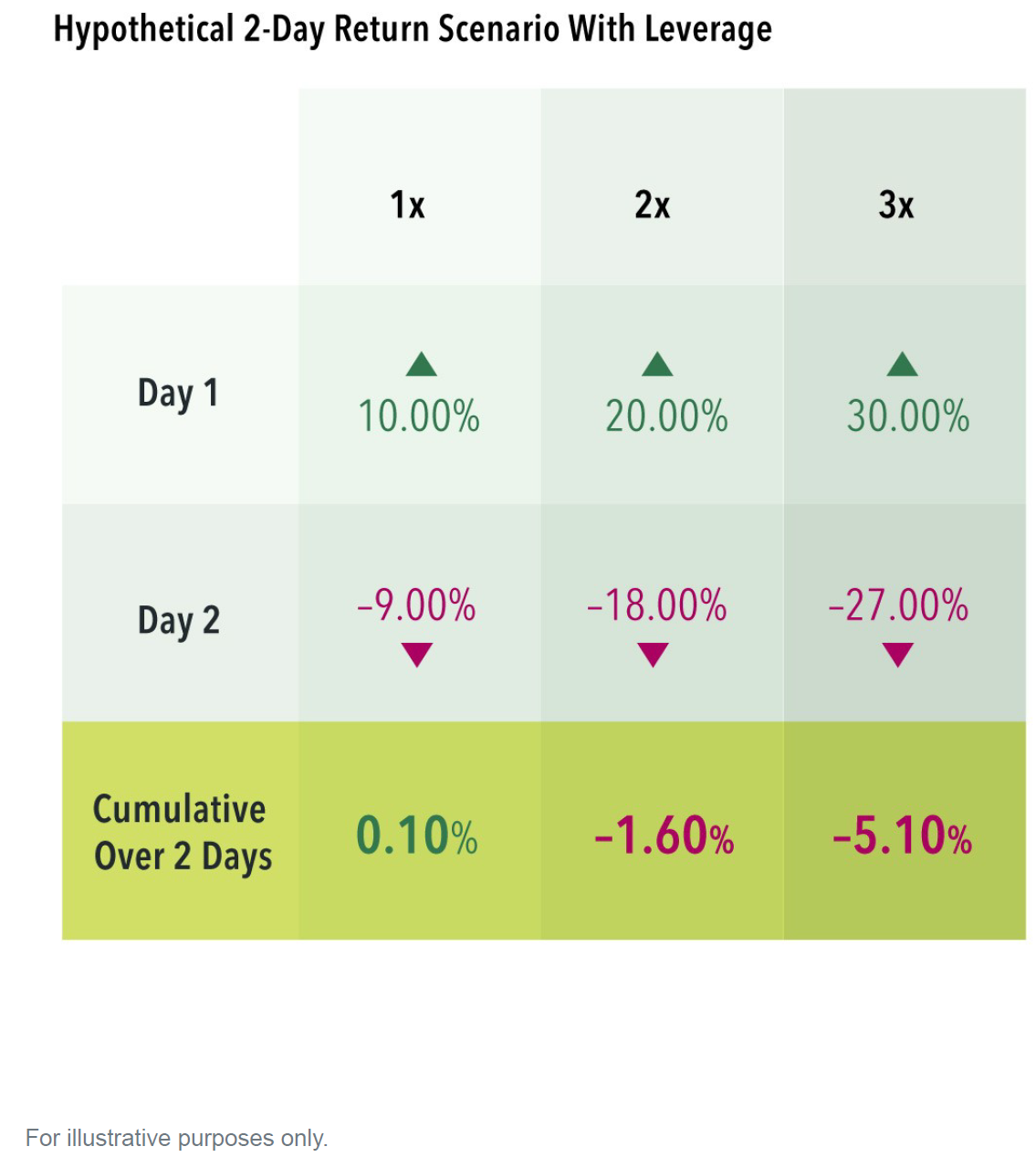
Amplified volatility can lead to unexpected outcomes for levered ETFs because magnifying stock price drops carve a hole that takes disproportionately longer to recover. For example, let’s say a hypothetical stock gains 10% in one day and loses 9% the next. The cumulative return with zero leverage (1X) is slightly positive, at 0.1%. But leveraging by 2X produces a negative cumulative return. The triple levered outcome is even worse.
Consequently, leverage may not always lift long-term performance even if average returns are strong. The largest levered single stock ETF tracks a stock that returned 23.0% as of September 28. The 2X ETF based on that stock returned 25.8%—an improvement but not
as dramatic as some investors might have expected.2
1. About 82% of assets under management as of August 31, 2026. Source: Morningstar
2. Source: Morningstar
Glossary
Cumulative Return: The total percentage change in an investment’s value over time.
Leverage: Using borrowed money to buy securities with the aim of increasing potential returns. Leverage can also increase losses.
Volatility: A statistical measure of the dispersion, or variability, of returns for a given security or portfolio. Volatility is often measured using standard deviation.
Disclosures
This information is intended for educational purposes and should not be considered a recommendation to buy or sell a particular security.
All expressions of opinion are subject to change. This information is not meant to constitute investment advice, a recommendation of any securities product or investment strategy (including account type), or an offer of any services or products for sale, nor is it intended to provide a sufficient basis on which to make an investment decision. Investors should consult with a financial professional regarding their individual circumstances before making investment decisions. Diversification neither assures a profit nor guarantees against loss in a declining market.
Risks include loss of principal and fluctuating value.
Adaptive Wealth Engineering is an investment advisor registered with the Securities and Exchange Commission.
Investment products: • Not FDIC Insured • Not Bank Guaranteed • May Lose Value
Adaptive Wealth Engineering does not have any bank affiliates.